Abschlussbericht "Tintenentwicklung für die Brennstoffzellen-Katalysator-Beschichtung" /TiKaBe) – Ein HyFab-Projekt
download [ PDF 3,74 MB ]Wasserstofftechnologien
Abschlussbericht "Tintenentwicklung für die Brennstoffzellen-Katalysator-Beschichtung" /TiKaBe) – Ein HyFab-Projekt
download [ PDF 3,74 MB ]
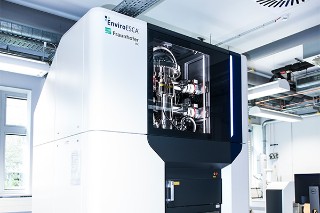
The innovative High-Temperature Near-Ambient Pressure X-Ray Photoelectron Spectroscopy (HT-NAP-XPS) brings conventional XPS to a new dimension of surface science. At Fraunhofer ISE we investigate functionalized surfaces at pressures up to 25 mbar and temperatures up to 1 000 °C allowing in situ studies of reaction mechanisms and their intermediate stages – especially attractive for materials used in hydrogen technologies.
download [ PDF 2.07 MB ]
The membrane electrode assembly (MEA) is the electrochemical heart of electrolyzers and fuel cells. Our production research, from catalyst powder to seven-layer MEAs, comprises the influences of process design and parameters, materials and component architecture on MEA cost, quality and performance.
download [ PDF 0.56 MB ]
A comprehensive in-situ characterization of the membrane electrode assembly (MEA) and its layers in terms of performance and degradation at different operation conditions provides the basis for our customers’ decisions on suppliers, production processes, fuel cell stack designs and operation strategies.
download [ PDF 0.56 MB ]
We model PEM fuel cells on all scales with commercial and self-developed codes from electrode structure to s ystem level, from flow field design with CFD to address scientific questions. We place particular emphasis on the experimental validation of our models, which provide you with detailed insights into the physical effects during fuel cell operation, with regard to cell perfomance and aging behavior.
download [ PDF 0.8 MB ]
Ex-situ analytics provides insights into the microstructure of hydrogen technology materials and components. Properties like pore and particle size, element distribution and concentration in liquids, etc. are measured using high-end analytical equipment without actually operating the components, thus saving time and money.
download [ PDF 0.8 MB ]
Sustainably produced hydrogen derivatives will play a major role as future energy carriers, as they can be transported and stored in existing infrastructure. New and efficient conversion via catalytic reforming processes will be decisive in spreading their utilization in all sectors.
download [ PDF 0.56 MB ]
Power-to-X (PtX) denotes the conversion of sustainable hydrogen and COx/N2 to energy carriers such as methanol, dimethyl ether and ammonia, which can also serve as sustainable chemicals or as clean fuels reducing CO2 and local emissions. PtX contributes to defossilization of all energy economy sectors.
download [ PDF 3.12 MB ]
The efficient and economically viable utilization of green hydrogen in various sectors requires a comprehensive understanding of all individual elements in the hydrogen supply chain. In our techno-economic analyses, we develop and evaluate tailor-made solutions for the production of clean hydrogen from renewable energy, its efficient storage and demand-oriented distribution.
download [ PDF 2.3 MB ]
We support our customers from the microscale up to global energy systems: We develop, model and analyze materials, components, production processes and infrastructure systems. In addition, we carry out technoeconomic and life cycle assessments.
download [ PDF 2.56 MB ]