Press Releases 2017

Cancel
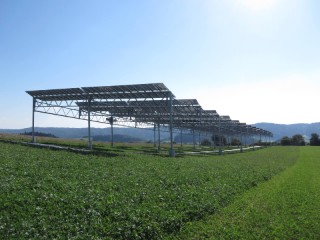
  • The agrophotovoltaics (APV) pilot plant located in Heggelbach near Lake Constance
    © Fraunhofer ISE

    Until now, acreage was designated for either photovoltaics or photosynthesis, that is, to generate electricity or grow crops. An agrophotovoltaics (APV) pilot project near Lake Constance, however, has now demonstrated that both uses are compatible. Dual use of land is resource efficient, reduces competition for land and additionally opens up a new source of income for farmers. For one year, the largest APV system in Germany is being tested on the Demeter farm cooperative Heggelbach. In the demonstration project “Agrophotovoltaic – Resource Efficient Land Use” (APV-Resola)” led by the Fraunhofer Institute for Solar Energy Systems ISE, solar modules for electricity production are installed directly above crops covering an area of one third hectare. Now the first solar harvest of power and produce has been collected on both levels.

    more info
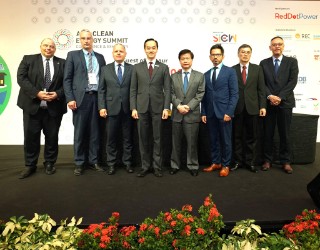

  • GECC launch ceremony
    © VDE

    The VDE Global Energy Storage Competence Cluster will serve the international cleantech sector along the entire value chain and features VDE Prime Labs in Singapore, Germany and the USA. VDE Renewables, together with the Fraunhofer Institute for Solar Energy Systems ISE and the Nanyang Technological University Singapore’s (NTU Singapore) Energy Research Institute (ERI@N), launched the Global Energy Storage Competence Cluster (GECC) today, at the annual Asia Clean Energy Summit in Singapore. This global initiative for energy storage will serve the international cleantech sector along the entire value chain and features VDE Prime Labs in Singapore, Germany and the USA. The VDE Prime Lab in Singapore will also be the first in the world to offer bankability and insurability certification for energy storage solutions at the systems level, which will plug a critical gap in the global energy landscape.

    more info
  • Visualization of the Center for High-Efficiency Solar Cells
    © BW+P Architekten

    For more than 30 years, the Fraunhofer Institute for Solar Energy Systems ISE has been one of the world’s leading research institutes for solar energy. In the field of photovoltaics, which focuses on converting sunlight into electrical energy, the institute has repeatedly set world records for efficiency for various solar cell technologies, thereby helping to put Germany at the forefront of international research and development in this area. In order to strengthen Germany’s leading position, the institute is now constructing a new building with a clean room equipped to handle the latest technological challenges. The cornerstone of the “Center for High-Efficiency Solar Cells” was laid on October 4, 2017 in Freiburg. By financing this building, the federal government and the government of Baden-Württemberg are signaling their commitment to photovoltaic research in Germany.

    more info
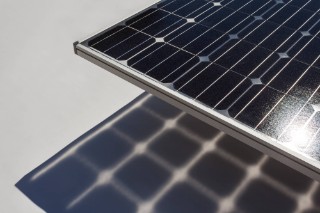
  • bifacial modules
    © Fraunhofer ISE

    At 1.3 percent measurement precision, the accredited calibration laboratory of the Fraunhofer Institute for Solar Energy Systems ISE achieved a record value. Measurement repeatability is 0.4 percent. Germany’s national accreditation body DAkkS has confirmed this value according to DIN EN ISO/IEC 17025:2005. The excellent measurement precision of CalLab PV Modules was also proven in a recent comparison of PV module calibrations between the four best-known calibration laboratories worldwide. For PV power plant investors, the precise calibration of PV modules translates into more exact yield predictions and thus lower financial risks. PV manufactures require high measurement precision to ensure the highest-level quality assurance in production and the power measurements of their products.

    more info
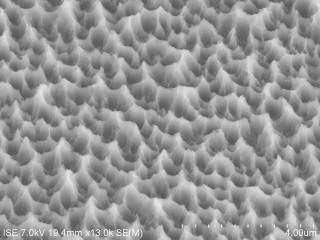
  • Plasma texture for multicrystalline silicon
    © Fraunhofer ISE

    Research and industry worldwide are working to further reduce the costs of solar electricity and German research is playing a leading role. With its newest solar cell, the Fraunhofer Institute for Solar Energy Systems ISE has now exceeded its own world record for multicrystalline solar cells. The record cell converts 22.3 percent of the incident sunlight into electricity.

    more info
  • Press Release #15 / 2017

    Two Directors Take Over as Head of Fraunhofer ISE

    July 10, 2017

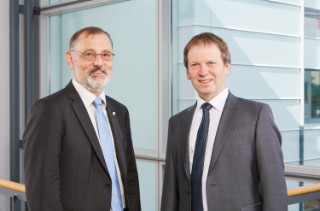
    Two directors take over as head of Fraunhofer ISE
    © Fraunhofer ISE

    As of July 10, 2017 it is official: Prof. Dr. Hans-Martin Henning and Dr. Andreas Bett will assume a dual leadership position as the new institute directors of the Fraunhofer Institute for Solar Energy Systems ISE. Both have been at Fraunhofer ISE, the largest institute for solar energy research in Europe, for many years. The two scientists are internationally renowned throughout the world in their field and collectively hold expertise in the areas of photovoltaics, building energy technology and energy system analysis. Both Henning and Bett were division directors and formerly deputy institute directors of the institute. Now that the appointment procedure has been finalized, they can officially succeed Prof. Dr. Eicke R. Weber as the next institute directors of Fraunhofer ISE.

    more info
  • bifacial modules
    © Fraunhofer ISE

    On July 6-7, 2017 the Fraunhofer Institute for Solar Energy Systems ISE is hosting the 7th PV Module Reliability workshop. This year the workshop will be held at the Solar Info Center, which is in close proximity to the laboratories of Fraunhofer ISE in Freiburg. The location provides an ideal setting for technical tours and discussions. This year the workshop focuses on the reliability of PV modules and systems, and speakers from throughout the world will be presenting talks related to this theme. The topics range from the newest improvements in measurement and test procedures to service life tests for PV modules.

    more info
  • Test stand for measuring bifacial PV modules
    © Fraunhofer ISE

    The calibration laboratory at the Fraunhofer Institute for Solar Energy Systems ISE has achieved a best value: Photovoltaic modules can now be calibrated with an even higher measurement precision of 1.3 percent. Repeatability lies at 0.4 percent. Measurement precision is a decisive factor for quality assurance in the module production and for investments in PV plants. For a volume of 10 MW, for example, each percentage point increase in measurement precision corresponds to a monetary value of about 60,000 euros.

    more info
  • Cross section of the PV inverter model
    © Fraunhofer ISE

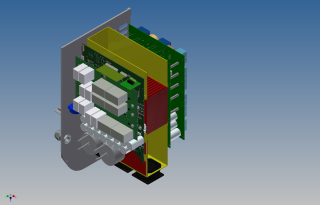
    The efficiency and reliability of solar power generation are largely determined by the properties of the PV inverter used. As a key component of a PV installation, the inverter converts direct current generated by the PV modules into alternating current for the power grid. Until now, research into electronic power converters has typically focused on increasing power density by using the latest semiconductor technologies and circuit topologies. However, new research approaches are needed to tackle the ever increasing cost pressures of a globalized PV economy. Researchers at the Fraunhofer Institute for Solar Energy Systems ISE and its project partners have teamed up to investigate what a new generation of PV inverters aimed at reducing costs could look like. Assembly, cooling and packaging technologies were identified as key areas where adjustments could be made.

    more info
  • Principle of the vehicle-integrated PV modules
    © Fraunhofer ISE

    Thanks to considerable cost reductions in photovoltaic modules, solar energy holds increasing appeal for use in the mobility sector. Depending on the type of application, even diesel fuel for trucks can be replaced by photovoltaics to some extent. Fraunhofer ISE has carried out and evaluated yield analyses of PV power supply for commercial vehicles, such as refrigerated transport vehicles, using real-life solar irradiance data. Based on its findings, the institute sees great potential in this field and is working together with partners from the logistics and automotive sectors to conduct research into special PV modules for use in commercial vehicles. The aim is to integrate the modules in the truck roofs to supply power for driving the vehicle or for cooling goods.

    more info
  • The Silicon PV – International Conference on Crystalline Silicon Photovoltaics is coming back to Freiburg where it began in 2011. The conference series was founded with the goal of offering an outstanding high-class scientific program on advanced technologies, materials and concepts for crystalline silicon solar cells and modules. This year, 370 participants from 25 countries have registered to attend. A special highlight of the program are the invited speakers: Prof Henry J Snaith, whose talk "Perovskite on Silicon Tandem Cells" focuses on a new concept for increasing the efficiency of today’s silicon solar cells; Dr. Kunta Yoshikawa, KANEKA Corporation, will present the company’s world record efficiency for a monocrystalline silicon solar cell in his talk entitled "Exceeding Conversion Efficiency of 26% by Silicon Heterojunction Technology."

    more info
  • © Fraunhofer ISE

    With the grid expansion and modernization process for the German energy transformation, a growing number of applications for advanced power electronics and grid technologies arise. Power electronic devices, or converters, are key for connecting power supplies, consumers and storage systems and are playing an ever more important role in our energy supply. Further, these devices must be tailored to meet the increasingly complex requirements that ensure the flexible and reliable operation of our future energy system. Against this background, the Fraunhofer Institute for Solar Energy Systems ISE is constructing a new lab site for the research, development and testing of the grid integration of renewable power, including controls for the low, medium and high voltage grids. Already most of the impressive lab infrastructure has been acquired and installed, and the new facility in the industrial area in North Freiburg is taking concrete shape.

    more info
  • multicrystalline world record solar cell made of n-type HPM silicon
    © Fraunhofer ISE

    The potential of photovoltaics (PV) has not yet been exhausted. Both industry and research continue to work intensively on increasing the efficiency and reducing the costs of solar cells, the basic component of every PV power plant. Now researchers at Fraunhofer ISE have produced a multicrystalline silicon solar cell with 21.9 percent efficiency, successfully bringing the world record back to Freiburg.

    more info
  • multicrystalline silicon wafer
    © Fraunhofer ISE

    From March 8-10, 2017, an International Conference on Crystal Growth is to be held in Freiburg under the auspices of the German Association of Crystal Growth DGKK and the Swiss Society for Crystallography SGK-SSCR. The conference, jointly organized by the Fraunhofer Institute for Solar Energy Systems ISE, the Crystallography department of the Institute of Earth and Environmental Sciences at the University Freiburg and the University of Geneva, is to be held in the seminar rooms of the Chemistry Faculty of the University of Freiburg. Furthermore, the Young DGKK will hold a seminar for young scientists at Fraunhofer ISE on March 7, 2017.

    more info
  • Press Release #4 / 2017

    Reliability of TPedge PV Modules Successfully Tested

    February 07, 2017

    TPedge module with 2 mm thick glass undergoing distributed load test
    © Fraunhofer ISE

    The TPedge concept reduces the material and production costs of PV modules, since encapsulation foils and the lamination process are no longer needed. At the same time, the aging stability of the PV module increases appreciably. In the project “TPedge,” researchers at Fraunhofer ISE together with their partners have developed processes so that the innovative PV modules can be manufactured on an industrial scale.

    more info
  • TABSOLAR component made of Ultra-High Performance Concrete (UHPC)
    © G.tecz Engineering GmbH

    When integrating renewable energy into the building envelope, solar thermal plays a significant role. So far, solar thermal products were generally based on metal components that conduct heat, absorb a high fraction of solar radiation and emit little infrared radiation to prevent thermal loss. Using this state of the art technology, building integration and architectural aspects are however often neglected. In the »TABSOLAR II« project, Fraunhofer ISE, together with partners, is following the new approach to produce solar-thermal collectors made from ultra-high performance concrete. Suitable procedures have already been tested. The project team is now working on the next steps for later product manufacture and connection concepts for building integration. The current developments will be presented at the BAU 2017 trade fair.

    more info
  • Web-based data visualization of the energy monitoring platform MONDAS
    © Fraunhofer ISE

    Through optimized operation management, up to 30 % of building energy consumption could be saved. Even low-cost investment measures could result in optimization and significant reduction of costs. In order to save energy, a detailed analysis of the building operation is necessary. For this purpose, Fraunhofer ISE developed the energy monitoring platform MONDAS, which provides all components necessary for collecting, saving, processing and visualizing relevant time-series data regarding building operation. The platform successfully pools software modules to a high-performance overall system. It will be presented at the BAU 2017 trade fair.

    more info
  • Press Release #1 / 2017

    Designing Architecture with Solar Building Envelopes

    January 16, 2017

    Visualization of a façade with strip collectors.
    © Facade-Lab

    Among the general public, solar thermal energy is currently associated with dark blue, rectangular collectors on building roofs. Technologies are needed for aesthetically high quality architecture which offer the architect more room for manoeuvre when it comes to low- and plus-energy buildings. With the “ArKol” project, researchers at Fraunhofer ISE together with partners are currently developing two façade collectors for solar thermal energy generation, which permit a high degree of design flexibility: a strip collector for opaque façade sections and a solar thermal blind for transparent sections. The current state of the two developments will be presented at the BAU 2017 trade fair.

    more info