Press Releases 2021

Cancel
  • © shutterstock.com/urbans

    Following the Bundestag’s decision of June 2021 on the Climate Protection Act (KSG), which tightened climate regulations and moved the goal for climate neutrality in Germany to 2045, the Fraunhofer Institute for Solar Energy Systems ISE recalculated the results of its study "Pathways to a Climate-Neutral Energy System" with its energy system model REMod. The Institute works with four scenarios to analyze the effects of societal trends on achieving the climate targets. The results show that the reduction targets are still achievable by 2045, but along different paths and at different costs.

    more info
  • This year the Fraunhofer Institute for Solar Energy Systems ISE celebrates its 40th anniversary. As the largest solar research institute in Europe with currently around 1300 employees, Fraunhofer ISE has been contributing to Germany’s energy transition since it was founded in 1981. Today, the institute has become a major global trailblazer and research partner for an energy supply based on 100 percent renewable energy.

    more info
  • Knowledge on refrigerant charge reduction gained from the LC150 project will be transferred to sys-tems with larger capacity in the new project.
    © Fraunhofer ISE

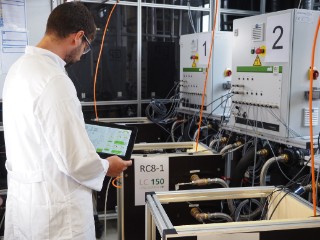
    The Fraunhofer Institute for Solar Energy Systems ISE is developing refrigeration circuits for heat pumps which shall operate as efficiently as possible with low amounts of the climate-friendly refrigerant propane. This research is carried out in project “LC150 - Development of a Refrigerant-reduced Heat Pump Module with Propane”, funded by the German Federal Ministry for Economic Affairs and Energy BMWi. In an automated cross-evaluation, a team from the institute is testing various components of heat pumps on the large scale, in which dozens of component combinations under different operating parameters are investigated. The main objectives are to further reduce the volume of required refrigerant, to identify methodological correlations and to obtain data for the simulation of heat pump design. The measurement campaign collects an abundance of parameter variations 24/7 over one year, thus generating a unique database.

    more info
  • Press Release #26 / 2021

    Electric Truck with Fully Integrated Photovoltaics Picks Up Speed

    October 25, 2021

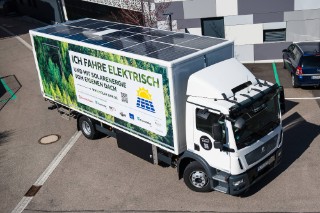
    A heavy-duty truck weighing 18 tons and equipped with a 3.5 kilowatt-peak photovoltaic system is now driving on Germany's roads. The commercial vehicle with integrated high-voltage photovoltaic system and feed-in to the 800-volt traction battery has been approved for road traffic. The solar power produced directly on the vehicle can cover 5 to 10 percent of the truck's energy needs. In the Lade-PV project, the Fraunhofer Institute for Solar Energy Systems ISE, with its project partners from industry and the Fraunhofer Institute for Transportation and Infrastructure Systems IVI, has developed solar PV modules and power electronics for integration in commercial vehicles. This truck, the first equipped with these PV modules, has now passed the technical inspection, marking a milestone towards more climate-friendly road freight transport.

    more info
  • M10 Industries AG and the Fraunhofer Institute for Solar Energy Systems ISE and have developed a matrix shingle concept for connecting silicon solar cells and a new stringer for manufacturing novel matrix shingle modules. The stringer, which arranges the shingle solar cells offset from each other similar to bricks in a masonry wall, was built within the Shirkan project, funded by the German Federal Ministry for Economic Affairs and Energy (BMWi). This shingle arrangement results in increased efficiency, a homogeneous appearance and improved shading tolerance of photovoltaic modules. The first prototypes for matrix shingle modules will be shown by Fraunhofer ISE at Intersolar Europe Restart 2021 (October 6-8, Messe München, Booth A6.370).

    more info
  • Cost efficient climate change mitigation requires installing a total of 20-80 TWp photovoltaics until 2050 and 80-170 TWp until 2100, at least a hundred times more than the 707 GWp standing at the end of 2020. A research team from the Fraunhofer Institute for Solar Energy Systems ISE and the Potsdam Institute for Climate Impact Research has now analyzed whether the projected growth is feasible from a resource point of view- and if so, under which conditions, in the paper »Technological learning for resource efficient terawatt scale photovoltaics« (Energy & Environmental Science, September 2021). The currently high rate of innovation must be upheld to avoid resource constraints, they find.

    more info
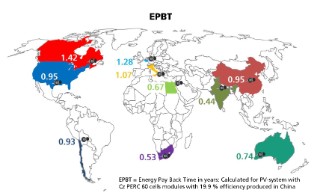
  • In a new study, researchers at the Fraunhofer Institute for Solar Energy Systems ISE have calculated that silicon photovoltaic modules manufactured in the European Union produce 40 percent less CO2 than modules manufactured in China. Using a life cycle analysis (LCA), the research team compared the CO2 footprint of monocrystalline solar modules manufactured in Germany, Europe and China. In the process, they also found that glass-glass modules enable an additional emissions reduction ranging between 7.5 to 12.5 percent compared to PV modules with backsheet films, regardless of their production location.

    more info
  • Press Release #21 / 2021

    First agrivoltaic system for carbon-neutral orcharding being tested

    September 14, 2021

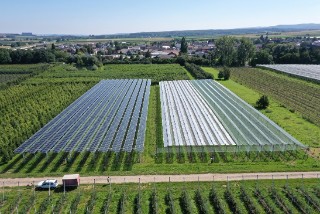
    As part of the project “APV-Obstbau”, BayWa r.e. and the Fraunhofer Institute for Solar Energy Systems ISE have cooperated with other research partners to set up an agrivoltaic system for research purposes at the “Bio-Obsthof Nachtwey” in Gelsdorf, Rhineland-Palatinate. It is the first system of its kind in Germany. The total test area for the project covers around 9100 square meters. The agrivoltaic system, which has a capacity of 258 kWp, has been installed on approximately one third of the plot.

    more info
  • Press Release #18 / 2021

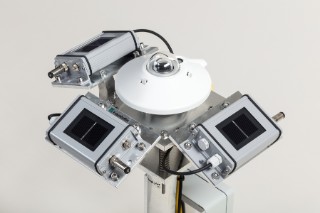
    Project PV-Live: New solar irradiance data set published

    August 04, 2021

    Reliable projections and forecasts of photovoltaic generation are becoming more and more important to maintain a stable power grid and for solar energy trading on the electric power exchange. To improve such projections, the Fraunhofer Institute for Solar Energy Systems ISE and the transmission system operator TransnetBW have set up a network of measurement stations which record the current irradiance conditions in the control area on a minute-by-minute basis. These data are also extremely valuable for research in solar energy meteorology. The project partners have released the first quality-controlled data sets, thus making measurement data since September 2020, now publicly available.

    more info
  • The Fraunhofer Institute for Solar Energy Systems ISE, supported by PSE Projects GmbH, has been publishing the PV Report on a regular basis for the past decade. The report contains a compilation of the most important facts on photovoltaics (PV) in Germany, the European Union and worldwide, documenting, in particular, the development of the photovoltaic market, solar cell and module efficiency as well as the prices over the last decades. The latest edition is freely available on the Fraunhofer ISE website as of today.

    more info
  • The Fraunhofer Institute for Solar Energy Systems ISE just presented the data on the net electricity generation for the public power supply for the first half of 2021 from the Energy Charts data platform. At 47.9 percent, the share of renewables in the electricity mix coming out of the socket was much lower than in the first half of 2020 (55.8 percent). In the first six months of 2021, solar and wind fed a total of 87.3 terawatt hours (TWh) into the public grid, compared with 102.9 TWh within the same time period in 2020. This was mostly due to the large drop in wind power, which declined by 20.5 percent compared to 2020. In contrast, the share of net electricity generation in the public power supply from brown coal (+37.6 percent), hard coal (+38.9 percent), gas (+18.6 percent), hydropower (+15.9) and nuclear power (+7.1 percent) all increased.

    more info
  • Example of a possible system design for floating PV.
    © Fraunhofer ISE

    Floating photovoltaic power plants can contribute to the expansion of renewable energy without taking up land. The Fraunhofer Institute for Solar Energy Systems ISE, RWE Renewables and the Brandenburg University of Technology Cottbus-Senftenberg (BTU) are working together to further develop this innovative technology with other partners. In the joint research project PV2Float, the partners are to test several floating PV systems with different structure designs under real conditions over a three-year period. An Evaluation for a suitable open pit lake for the implementation is currently ongoing.

    more info
  • © Fraunhofer ENIQ

    Fraunhofer Energy Research has a new location: the showroom "ENIQ - Energy Intelligence by Fraunhofer" located on the EUREF campus in Berlin. The facility functions as an interactive platform to serve the transfer of knowledge. Stake-holders from business, politics and society can discuss relevant topics with sci-entists, initiate projects and create innovations. Event formats for different tar-get groups are complemented by an exhibition area where innovative demon-strators and exhibits from Fraunhofer Energy Research are on display.

    more info
  • 68.9 Prozent Rekordzelle
    © Fraunhofer ISE / Foto: Henning Helmers

    In addition to the classical applications for solar cells on roofs and open spaces, photovoltaic devices can also be used with laser light for efficient power transmission. At the 48th IEEE Photovoltaic Specialists Conference, researchers from the Fraunhofer Institute for Solar Energy Systems ISE recently presented how they were able to achieve a record conversion efficiency of 68.9% with a photovoltaic cell under monochromatic laser light. For this, the research team used a very thin photovoltaic cell made of gallium arsenide and applied a highly reflective, conductive mirror on the backside.

    more info
  • Stromgestehungskosten für erneuerbare Energien und konventionelle Kraftwerke an Standorten in Deutschland im Jahr 2021
    © Fraunhofer ISE

    Researchers at the Fraunhofer Institute for Solar Energy Systems ISE have presented the newest edition of their study on the levelized cost of electricity (LCOE) of renewable power plants. The fifth edition of the study analyzes the current costs and forecasts the future cost development up to 2040 based on technology-specific learning rates and market scenarios. "Wind and solar power plants in Germany have significantly lower LCOE costs than conventional power plants. Due to the rising price of CO2 certificates, the cost competitiveness of even existing coal and gas-fired plants will further decrease in the coming years," says project head Dr. Christoph Kost.

    more info
  • In a brief study, scientists in the Energy Systems Analysis department at Fraunhofer ISE recently evaluated the data of photovoltaic systems registered in the Market Master Data Register (MaStR) and the master data set for subsidized systems. An important finding of the analyses is that the largest growth in PV capacity is taking place in the sector of rooftop PV systems larger than 100 kW. This sector accounts for 38 % of new PV systems. Also interesting is that 22 % of the newly installed PV systems are oriented to the west, east or east-west, and 19 % of these systems have tilt angles smaller than 20 degrees.

    more info
  • Hybrid modules city hall Freiburg
    © Fraunhofer ISE

    After completion in 2017, the city administration building "Rathaus im Stühlinger" in Freiburg was measured and analyzed in detail during the first years of operation. The good news is that the targets set in the planning phase agree with the actual consumption data to a large extent. The building and the building systems are highly efficient. In a yearly balance, the total energy consumption for the building conditioning (heating, ventilation, lighting, domestic hot water heating) is met almost entirely by the renewable energy produced onsite. Thus, the goal of achieving a net zero energy building has been achieved.

    more info
  • JOINT PRESS RELEASE BY FRAUNHOFER ISE, ÖKO-INSTITUT AND HAMBURG INSTITUT / 2021

    How the Building Sector Can Achieve Its Climate Targets After All

    May 11, 2021

    With the currently adopted climate protection measures, Germany will neither achieve its previous, nor the more stringent European, climate protection targets in the building sector by 2050. Two roadmaps from the Fraunhofer Institute for Solar Energy Systems ISE, the Öko-Institute and the Hamburg Institute show how this achievement, however, can be made possible. The research team presents the adequate measures and policy instruments with which decentralized heat generation no longer emits carbon dioxide, final energy consumption can be reduced, and heat grids can be expanded. The analyses and the roadmaps underline the great urgency with which policymakers must act: Most of the instruments should be introduced and implemented before 2025. The research results, including the detailed analysis and roadmaps, are presented in the study "The Systemic Challenge of the Heat Transition" which was commissioned by the German Federal Environment Agency.

    more info
  • Center for High Efficiency Solar Cells
    © Fraunhofer ISE / Photo: Guido Kirsch

    Fraunhofer ISE has been developing photovoltaic technologies, since it was founded forty years ago. Over this period, the institute’s research has contributed significantly to the establishment of solar electricity today as the most cost-effective form of energy supply worldwide. In order to maintain and strengthen its global leadership position in solar energy research, Fraunhofer ISE has now gained a new laboratory building, which was funded in equal parts by the German Federal Ministry of Education and Research BMBF and the State of Baden-Württemberg. The new Center for High Efficiency Solar Cells was officially opened on April 27, 2021 in a virtual ceremony. In his welcoming address on the occasion of the inauguration of the new Fraunhofer ISE laboratory building, Minister President Winfried Kretschmann said: "In Baden-Württemberg, we have set ourselves numerous goals for climate policy, and solar energy plays a central role. With Fraunhofer ISE, we have had one of the most important solar research institutes worldwide right here in the State of Baden-Württemberg for over 40 years. I am therefore very pleased that we are again able to give cutting-edge photovoltaic research a powerful boost with the Center for High Efficiency Solar Cells, which I have the pleasure of inaugurating today, moving us towards becoming the number one climate-friendly state of the future."

    more info
  • III-V//Si tandem solar cell
    © Fraunhofer ISE / Photo: Michael Schachtner

    Fraunhofer ISE has been conducting cutting-edge research in photovoltaics for forty years. Continually the institute has brought forth record cell efficiencies in different material classes and made important contributions in reducing the costs of solar electricity, which is the cheapest form of energy generation today. Photovoltaics, along with wind energy, is the central pillar of the energy transition. Aiming to further reduce the area required for PV installations as well as material use, Fraunhofer ISE is focusing on tandem photovoltaics. This cell technology allows the traditional efficiency limits to be exceeded by selectively combining different solar cell materials. The Freiburg researchers have again succeeded in setting a new world record with a monolithic tandem cell made of III-V and silicon semiconductors.

    more info