 Fraunhofer Institute for Solar Energy Systems ISE
News #33
ReNew Project: Scaling MW Charging Stations in a Technically and Economically Viable Manner
Large capacities of fast-charging infrastructure are being built to electrify the transport sector. Stations with megawatt fast-charging points for heavy-duty vehicles on high-traffic routes require charging capacities equivalent to the power requirements of a small town (30 MW). The “ReNew – Resilient Fast Charging Parks for Heavy Goods Vehicles” project aims to develop system concepts for megawatt charging stations for the first time that pursue a holistic and technically and economically scalable approach. The consortium will develop and build the central medium-voltage components and test them on a laboratory scale. At the heart of the innovation is local energy distribution with direct current at medium-voltage level.
The Megawatt Charging Standard (MCS) already allows charging capacities of one to three megawatts per charging point and thus currents of up to 3000 amps. The first components for setting up these charging points up to one megawatt are available, but there are no reasonably scalable system concepts.
This is where the “ReNew” project comes in: It considers all components and the entire system technology for the optimization of economic efficiency and resource efficiency and develops the necessary components to realize energy distribution with direct current at medium voltage level. In addition to cost optimization and increased efficiency, the central project goals also include resource efficiency, both during installation and during operation of the charging stations.
Fast charging parks combined with photovoltaics
The fast charging parks are considered hybrid power plants in the project, which means that both battery storage and PV systems are integrated into the system design. Due to the large areas of car parks, photovoltaic systems can reach a capacity of 1 MW when used as parking lot roofing. Since solar power generation correlates very well with charging demand on transport routes, peak loads in the power grid can be buffered and the fast-charging park's own consumption increased. The fast-charging park remains operational even in the event of a grid failure and could supply critical consumers via the public grid as a decentralized power storage facility.
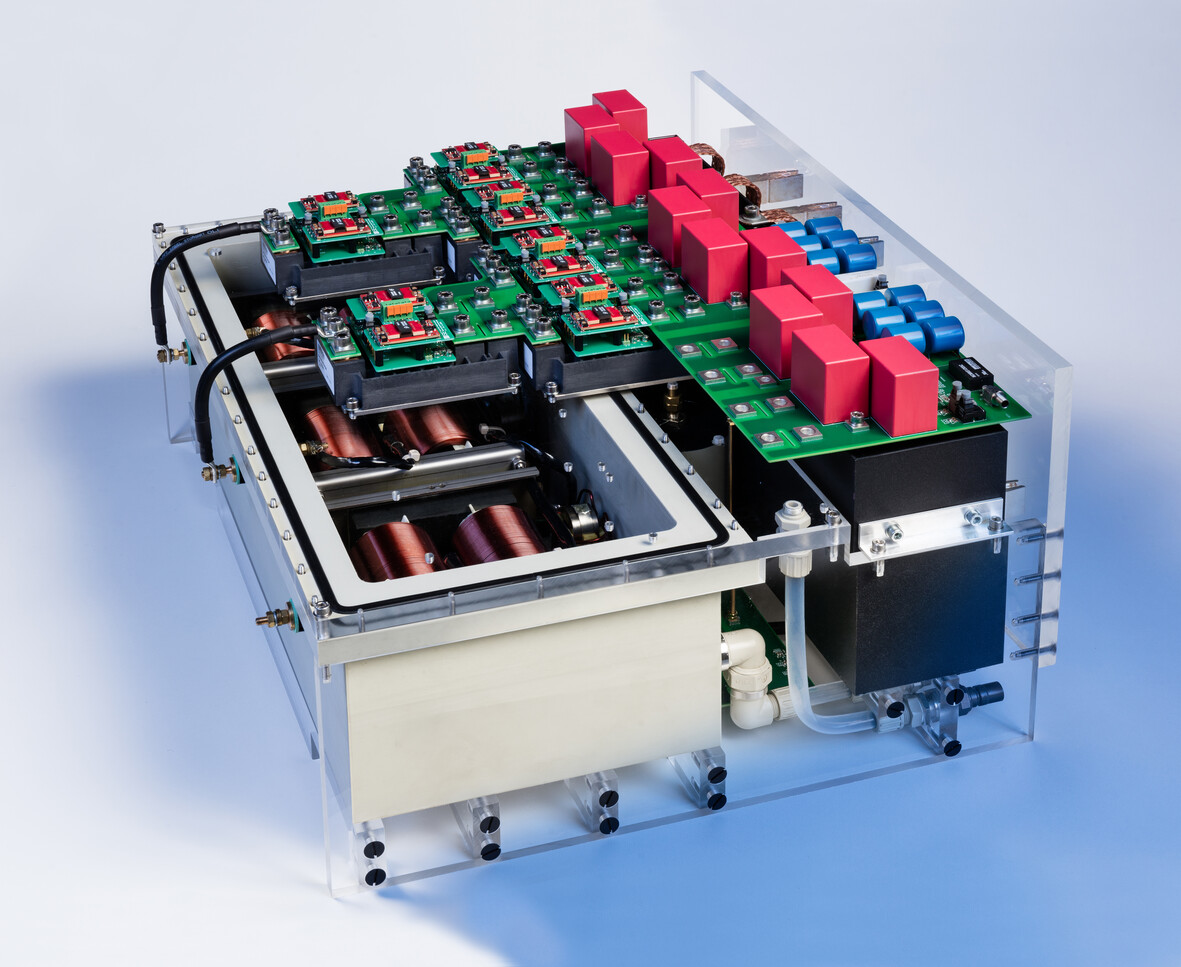
The core of the innovation consists of transferring energy in the charging park via a multiport DC distribution network with a voltage of 3000 to 5000 volts. This is connected to the medium-voltage or transmission grid via central rectifiers that serve the grid. Insulating DC converters are connected to the charging points in the charging park. The aim of the project is to develop the two central power electronics systems (grid rectifier and DC converter for the vehicle or battery).
Efficient power electronics for a stable power grid
Because the high currents that occur during megawatt charging pose a major technical challenge on the vehicle side, the project team is developing inductive components and DC protection elements in addition to the power electronics demonstrators. In addition to their main function as charging electronics, the insulating DC converters should also be able to be used to connect photovoltaic systems. The focus of the grid rectifiers to be developed is on the efficiency of the grid-friendly control technology and the modular design and bidirectionality in order to ensure stability in the power grid of the future.
The approach chosen in the project, which involves a high DC distribution voltage, reduces the use of resources for cables and other system components. At the same time, the lower currents mean that operating losses can be reduced.
The central system components (grid rectifier, DC converter, semiconductors, winding materials, and DC switching device) developed by the project consortium in the corresponding voltage class will then be tested on a laboratory scale at Fraunhofer ISE.
The project is supported by the German Federal Ministry for Economic Affairs and Energy as part of the 8th Energy Research Program of the German Federal Government, “Innovations for the Energy Transition.” Infineon Technologies AG, Siemens AG, STS Spezial-Transformatoren-Stockach GmbH & Co KG, and Gruner AG are participating as cooperation partners.
Last modified: