 Fraunhofer Institute for Solar Energy Systems ISE
| Duration: | 03/2017 - 02/2021 |
| Contracting Authority/ Sponsors: | BMWi |
| Project Partners: | Umicore AG; Aixtron SE; Sempa Systems GmbH; AZURSPACE Solar Power GmbH |
| Project Focus: |       |
KoReMO – Cost Reduction and Resource Efficiency by New Supply Systems for Metal-Organic Precursors for Epitaxy of III-V High-Power Solar Cells
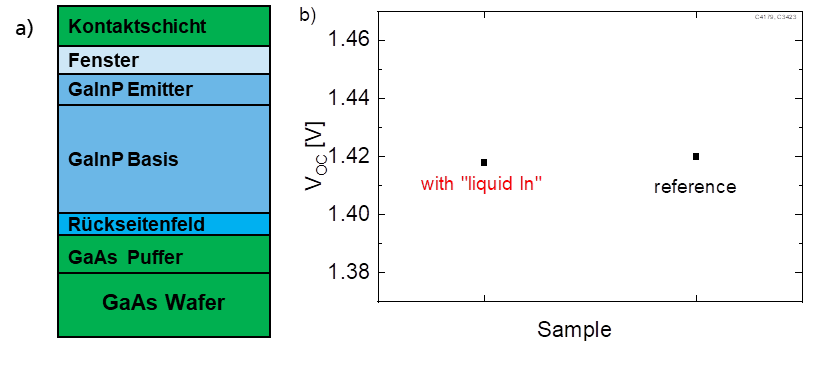
a) Schematic diagram of the GaInP solar cell structure. b) Open clamping voltage under illumination with AM1.5g for the first GaInP solar cell manufactured using the new liquid indium precursor with direct vaporizer in KoReMO compared to a reference cell with conventional precursors.
Today, solar cells made of III-V semiconductors achieve the highest conversion efficiencies of up to 46% worldwide and are used industrially in satellites and in concentrator PV systems. The light is bundled about 500 times in these highly concentrated modules to reduce the surface area and thus the proportionate costs of the III-V solar cells. Half of the epitaxy costs for III-V multi-junction solar cells relate to the organometallic starting materials trimethylindium and trimethylgallium (so-called "organometallic sources or precursors") for the MOVPE manufacturing process. The project KoReMO should demonstrate that these epitaxy costs can be reduced by about half by using new indium sources and a new feed system for both trimethylindium and trimethylgallium. The feed system should also enable higher growth rates for GaAs and GaInP. The improvements will be demonstrated using currently established GaInP/GaInAs/Ge triple-junction solar cells.
At Fraunhofer ISE, the new indium liquid source with vaporizer is being tested as well as a central vaporizer for trimethylgallium (Vaporbot). The two new evaporation sources were integrated into the existing MOVPE planetary epitaxy reactor (AIX2800G4-TM) and put into operation. First tests with GaInP solar cells show a comparable solar conversion efficiency as the comparison sample with conventional precursors.