Research Projects

Cancel
  • © Fraunhofer ISE

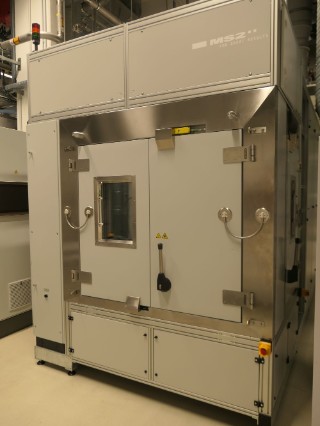
    Test rig for fuel cell stacks up to 200 kWel with extended temperature range, temperature chamber and multi-channel impedance spectroscopy.

    High-performance test environments are needed to support the development of powerful, series-ready, high-quality fuel cell stacks. FullStackTS therefore aimed to set up and validate a test environment and develop a non-discriminatory range of tests for the fuel cell industry. At the end of the project, a test bench from MS2 Engineering for fuel cell stacks up to 200 kW with specialised measurement technology from SMART Testsolutions is available at Fraunhofer ISE for contract and collaborative research. | Duration: 01/2022 - 07/2025

    more info
  • TransHyDE project LNG2Hydrogen
    © Grafik: Projektträger Jülich im Auftrag des BMBF

    Conversion of LNG terminals into future-proof logistics hubs for hydrogen and its derivatives.

    The "LNG2Hydrogen" project works on the possible conversion of LNG terminals for use with hydrogen-based energy carriers. The current conditions are analyzed and the necessary technical and legal adjustments are identified. In addition, the technical and logistical challenges of onward transportation within Germany are analyzed. | Duration: 06/2023 - 11/2024

    more info
  • The natural refrigerant R290
    © Bosch Thermotechnik GmbH

    The natural refrigerant R290.

    The project network »QUEEN-HP« combines method development for acoustic analysis and evaluation of heat pumps and their components with solution developments in technology projects with new components in heat pumps, new forms of sound attenuation and innovative energy-efficient and future-proof equipment modifications. | Duration: 01/2023 - 12/2026

    more info
  • 1 MWh Redox Flow Grid-Connected Storage

    Development and Optimisation of Redox Flow Batteries
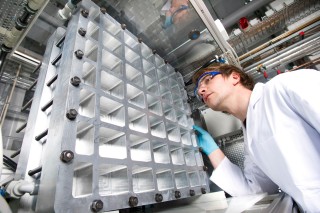
    Testing a new stack design for a 5 kWel redox-flow battery
    © Fraunhofer ISE

    Testing a new stack design for a 5 kWel redox-flow battery with 40 cells and a cell area of 2000 cm2.

    To develop a scalable electricity storage unit with an electric power of 100 kWel and a capacity of 1 MWhel, we are working on the stack and system development and the management of redox flow batteries at Fraunhofer ISE. By applying simulation-supported analysis and design of redox flow batteries, we identify optimisation potential at the cell and stack level and use this to further develop the design. Within the “1 MWh Redox-Flow Netzspeicher” project on grid-connected storage, we have developed an optimised cell stack with a power of 5 kWel for use in mini-grid systems or gridconnected storage systems. Cycling efficiency values of above 80% have been achieved at the stack level. Current research is concentrating on further increasing the power and energy density and reducing the production costs of a 5kWel cell stack. | Duration: June 2010 - February 2013

    more info
  • Structure of the process of energy system modeling between the different stakeholders.
    © Fraunhofer ISE

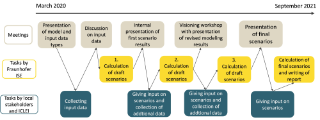
    Structure of the process of energy system modeling between the different stakeholders.

    In order to achieve the Paris climate protection target of net zero emissions in the second half of this century, an unprecedented transformation of the energy supply towards renewable energies (RE) is required in all sectors worldwide. In the target countries of this project, Indonesia, Argentina and Kenya, the potential of RE has so far been insufficiently utilized and the existing national framework conditions are not yet sufficient to increase the share of RE. This project therefore supports cities and regions in these countries in developing strategies for 100% RE supply and in raising awareness and commitment among stakeholders. At the same time, it supports the assessment of local RE potential and the development of eligible projects for the expansion of RE. The project thus provides tools and resources for a RE-based energy supply. | Duration: 03/2020 - 03/2023

    more info
  • Visualization of a PV car roof with shingled solar cells.
    © Fraunhofer ISE

    Visualization of a PV car roof with shingled solar cells.

    The integration of photovoltaics into existing surfaces, devices and envelopes requires new module concepts and thus module manufacturing processes. Curved PV modules can be used in e-vehicle roofs, for example. The prototype of a curved PV car roof was manufactured at Fraunhofer ISE in 2019. In order to be able to manufacture curved PV modules industrially, an industrial laminator as well as the required processes and module concepts are being developed in the "3D" project. In addition, methods for mechanical and electrical characterization are being developed and tested. Solar cell strings are examined by Magnetic Field Imaging (MFI) and conductive adhesives by Dynamic Mechanical Analysis (DMA). | Duration: 02/2021 - 01/2024

    more info
  • Thermal storage units are a central component of climate-neutral heat supply. Storage systems covering a wide range of sizes and temperature ranges are required for buildings, district and municipal heating networks, and industrial applications. In the DRUCKSTORE project, Fraunhofer ISE, together with IPROconsult, IAB Weimar, and m-tec, is developing new manufacturing methods based on concrete 3D printing using ultra-high-performance concretes (UHPC). This combination aims to enable the production of highly integrated storage units with minimal material usage, thereby creating cost-effective and efficient solutions. | Duration: 11/2025 - 10/2028

    more info
  • Qantum efficiency measurement of a wafer bonded 4 junction solar cell
    © Fraunhofer ISE

    Quantum efficiency measurement of a wafer-bonded 4-junction solar cell.

    The primary goal of the 50Percent project is to produce the first multi-junction solar cell with an efficiency value of 50% and a concentrator module with 40% efficiency. The project also seeks to develop measuring technology so that the cells can be measured in accordance with internationally recognized calibration standards. The project aims to impressively demonstrate German PV research excellence. | Duration: 03/2020 - 05/2024

    more info
  • Mock-up of a transparent organic solar module manufactured with a still strongly absorbing organic semiconductor material. In the project, such modules with electrical function and higher transparency are to be manufactured and the technology presented to interested users on the basis of these demonstrators.
    © Fraunhofer ISE

    Mock-up of a transparent organic solar module manufactured with a still strongly absorbing organic semiconductor material. In the project, such modules with electrical function and higher transparency are to be manufactured and the technology presented to interested users on the basis of these demonstrators.

    Climate change has become a tangible reality in Germany in recent years. Heatwave summers and low precipitation in winters have led to massive problems in agriculture in many places. Protected cultivation under foils is a current trend, causing additional costs and waste problems. In this project, highly transparent organic solar cells will be developed that allow visible light, which is important for plants, to pass through and use the infrared portion to generate electricity. These could make it possible to simultaneously generate the urgently needed solar power for a successful energy and mobility turnaround from the film covers that are intended to protect plants from heavy rain, hail, sunburn and desiccation. | Duration: 09/2021 - 07/2024

    more info
  • © Fraunhofer IFAM

    Sintered aluminum fiber material coated with adsorbent material (SAPO-34).

    The objective is the development of a heater on zeolite basis with water as operating medium, which based on novel absorption heat exchangers and optimized functionality of evaporator and condenser is significantly more compact and cost-effective than the devices on the market with comparable outputs and an annual COP of over 1.3. Porous materials with good thermal conductivity are of central importance for the development of absorption heat exchangers. A large surface paired with thin sorbent layers (< 100 µm) accelerates the dynamics of the ad- and desorption process. It thus offers a larger potential for a higher power density of the sorption module of the gas heat pump. | Duration: 05/2013 - 04/2017

    more info
  • AEGIR

    DigitAl and physical incrEmental renovation packaGes/systems enhancing envIronmental and energetic behaviour and use of Resources

    85% of the European building stock was built before 2001 and does not meet low-energy standards.In order to achieve the necessary climate targets by 2050, Europe must accelerate the renovation wave! For the building envelope, four different renovation concepts are being developed in the project using the example of demonstration buildings, which are tailored to the needs of different building types, climate zones, social classes and user preferences. They can be scaled up and adapted to new or existing buildings throughout Europe. | Duration: 10/2022 - 09/2026

    more info
  • AGEE-Stat

    AGEE-Stat - Scientific Analyses of Specific Statistical Aspects of Renewable Energy to Support the Working Group on Renewable Energy Statistics

    Sample project for roof-top PV systems in commerce, trade and services (parking garage in Freiburg, Germany)
    © triolog-freiburg

    Sample project for roof-top PV systems in commerce, trade and services (parking garage in Freiburg, Germany).

    The Working Group on Renewable Energy Statistics (AGEE-Stat) has been commissioned by the Federal Ministry for the Environment, Nature Conservation and Nuclear Safety (BMU) to investigate and provide key data on renewable energy which is needed on a national and international level. It is led by the central office at the Federal Environment Agency (UBA), which also provides scientific and organizational support. Fraunhofer ISE is responsible for offering scientific support in the areas of photovoltaics and heat pumps (environmental heat/ shallow geothermal energy) within the project. | Duration: 04/2019 - 06/2022

    more info
  • © AI4CITIES

    In the EU-funded "AI4Cities" project, leading European cities such as Amsterdam, Helsinki and Stavanger are coming together to search for solutions based on artificial intelligence (AI) for decarbonization in the areas of mobility and energy. For many cities, district heating is a central pillar in their decarbonization strategy. Continuous and automated monitoring of district heating substations can ensure energy-efficient and economical operation of district heating networks. With the help of Symvio's software solution, which is being developed in the AI4CITIES project together with Fraunhofer ISE, utilities and clients such as technical municipalities can better monitor and optimize the operation of their district heating connections and thus reduce energy consumption and save CO2. | Duration: 04/2021 - 03/2022

    more info
  • AI4Grids

    AI - based planning and operational management of distribution grids and microgrids for the optimal integration of renewable generators and fluctuating loads in the context of the energy transition.

    Control room in the Digital Grid Lab of Fraunhofer ISE as a central control point for grid operation with AI processes.
    © Fraunhofer ISE

    Control room in the Digital Grid Lab of Fraunhofer ISE as a central control point for grid operation with AI processes.

    To slow climate change, we need a shift away from fossil energy sources. However, the necessary expansion of renewable energies and the switch to electric cars pose challenges for the power grid: Solar and wind energy feed power into the grid very irregularly, while electricity energy demand is constant or increasing, especially in cities. Nevertheless, new flexible consumers, such as electric cars and heat pumps, can become the solution for the energy transition in interaction with fluctuating renewable generators - through intelligent grid control. | Duration: 09/2020 - 12/2023

    more info
  • AIIR-Power

    AI-assisted design and fabrication of photonic infrared power converters for energy and telecommunication

    © Graphic: istock.com / Peshkova / Editing: Fraunhofer ISE

    Photonics and optoelectronics are key technologies for the digitalization. The design of corresponding semiconductor devices as well as the modeling of epitaxial processes can still benefit significantly from artificial intelligence (AI) methods in the context of Industry 4.0. Ubiquitous digitization and automation, as well as the Internet of Things, require constant energy and data streams. The emerging technology of photonic power transmission, also known as power-by-light enables power and data transmission to be combined in a single optical link. By using optical telecommunication wavelengths around 1.5 µm, the applications of such power-by-light systems can be extended to remote locations, enabling unlimited remote power supply. AI-assisted approaches to photonic power converter (PPC) design and fabrication are critical for further cross-industry application of photonic power and data transmission. | Duration: 04/2021 - 03/2024

    more info
  • ALCHEMI - Module and manufacturing concept
    © Courtesy of Fullsun Photovoltaics Limited, U.K.

    Module and manufacturing concept of the HCPV technology investigated in the ALCHEMI project, aiming at highly efficient, cost effective and compact modules.

    In (highly) concentrating photovoltaics ((H)CPV), solar radiation is focused on small but highly efficient solar cells, resulting in high overall efficiencies. Increased efficiency and cost-effective production technologies contribute to further costs reductions. In the ALCHEMI project, a HCPV module is to be developed within a European consortium with central components (primary optics, cell) potentially being provided by German suppliers. The secondary optics are manufactured through procedures established in optoelectronics. Fraunhofer ISE optimizes the design of the two-stage concentrator optics and characterizes the prototypes. The thermal design is also being assessed by Fraunhofer ISE. | Duration: November 2016 - January 2020

    more info
  • Alfama Cell
    © Fraunhofer ISE

    Ultralight flexible GaInP/GaAs/GaInAs inverted metamorphic triple junction solar cell with an cell area of 22 cm^2. The active solar cell layers have been transferred form the growth substrate to a thin metal foil. The epitaxy process is developed at Fraunhofer ISE, while the project partner TF2 Devices from Nijmegen is responsible for the device processing including the lift-off.

    Project in the Business Area: Photovoltaics; Topic: III-V and Concentrator Photovoltaics; Field of Work: III-V Epitaxy and Solar Cells; Duration: 11/2018 - 10/2021

    more info
  • ALPRO - Solar radiation forecasts
    © Fraunhofer ISE

    Solar radiation forecasts (red) with uncertainty (gray) compared with measurements of solar radiation (blue). The graph shows a low forecast uncertainty on days with clear skies and a high forecast uncertainty on days with varying cloud formation. Data basis: Forecasts based on numerical weather predictions for the next day.

    The goal of the project is the provision of algorithms to generate intra-day and day-ahead forecasts of PV power generation optimized for the specific PV system and its location. The algorithms to be developed are supposed to increase the economic efficiency of decentralized energy management systems with respect to one or several specified variables, such as the maximization of internal consumption, prevention of curtailment, grid usefulness, peak load reserve or storage design. | Duration: September 2016 - December 2019

    more info
  • Details of a neuron (nerve cell).

    The control is an important system component of solar thermal systems. Programming of the control algorithms incurs significant component costs. Here, the use of the neural network methodology could result in significant cost advantages. At the same time, this also offers new possibilities for control optimization with respect to energy consumption optimization. The main objective of the “ANNsolar” project is the development and demonstration of the monetary and technical advantages of the neural network methodology. The option to generate self-learning algorithms enables the realization of complex control strategies for increased energy efficiency in a significantly simpler manner. | Duration: October 2014 - June 2018

    more info
  • APOLO - Improvements defined by the APOLO consortium
    © Projekt Apolo

    Improvements defined by the APOLO consortium to the Perovskite technology during the four-year project. A stable, cost-effective, flexible and fully printed Perovskite solar module will be developed using environmentally friendly processes.

    Over the past decade, Perovskite solar cells (PSC) have shown an impressive learning curve and have achieved an efficiency of 23% on rigid substrates since July 2018. The aim of the APOLO project is to provide flexible and stable PSCs using scalable and cost-effective processes with module costs below 0.40€/Wp. The APOLO consortium will work on advanced materials and innovative green processes to develop flexible and fully printable PSCs. A target efficiency of 22% is set, with stability criteria of 90% of the output power according to standard tests for accelerated ageing. APOLO aims to increase the Technology Readiness Level (TLR) of PSC technology. The solutions found in the APOLO project will allow the development of a completely new product by integrating modules into the architecture of buildings. Entry into new markets such as automobile, textile, etc. is also possible. | Duration: 04/2018 - 03/2022

    more info
  • Schematic diagram of a triple land use through agrivoltaics
    © Fraunhofer ISE

    Schematic diagram of a triple land use through agrivoltaics.

    The agrivoltaic project in Mali and the Gambia (APV-MaGa) is a research and development project that aims at proofing the technical and economic viability of an integrated triple land-use system in order to contribute to a more ecological and socio-economic sustainable development of the partner countries and in general, the West African economy. Thus, the double land use of agrivoltaics is extended by the range of water management. Furthermore, APV-MaGa aims at uniting agricultural research, socio-economic strategies and solar energy expertise to reveal challenges and opportunities of APV systems and to gain a deeper understanding of synergies and interactions between the Food-Water-Energy-Nexus. | Duration: 08/2020 - 12/2023

    more info
  • APV Orcharding
    © Fraunhofer ISE

    The experimental setup compares five different variants.

    The agricultural sector is facing new challenges. In the wake of climate change, strategies must be developed to avoid negative impacts on harvests. Orcharding in Germany is already affected by the consequences of climate change: rising temperatures, changes in precipitation distribution and increasingly frequent extreme weather events such as hail and heavy rain. As a result, commercial fruit growers are increasingly using hail protection nets and foil roofing to prevent quality and yield losses. The project "APV-Obstbau" (Agrivoltaic Orcharding) will investigate to what extent agrivoltaics can replace these protective measures in apple cultivation, which system design makes sense for this crop and in which way the agrivoltaic system affects crop yields. | Duration: 04/2020 - 03/2025

    more info
  • © Fraunhofer ISE

    Concept of an APV system.

    The costs of ground-mounted PV systems continue to fall. Experts forecast that in about five to eight years, such PV installations will become cost-effective even without the financial support of the Renewable Energy Act (EEG). Decreasing costs spurn on new types of business models for land use and as a result new challenges arise. Increased competition for land use, for example, can cause the rental price for land to rise. The innovation group APV-RESOLA is therefore developing and investigating a new type of PV system that ensures the coexistence of agriculture use and electricity production on the same piece of land. | Duration: 03/2015 - 01/2021

    more info
  • © AIRBUS S.A.A. 2009

    In our department “III-V - Epitaxy and Solar Cells” photovoltaic converters for monochromatic light have been developed for many years. Beside cell development and optimization, we have experience in packaging and system integration. Within the ASHLEY project we work on the optimization and system integration of laser power converters for a power-by-light module in aircrafts. | Duration: 10/2013 - 09/2017

    more info
  • 3D model of a fabric to model the load in the printing process.
    © Fraunhofer ISE

    3D model of a fabric to model the load in the printing process.

    In the age of digitization, the question arises as to how established printing technologies such as the flatbed screen printing process can be transferred into the digital space. Key challenges such as reducing structure widths or maximizing production throughput could be handled more cost-effectively and faster with the help of a digital twin. The outlined project represents an approach to digitizing the flatbed screen printing process and includes the optimization of production parameters using CFD simulation and artificial intelligence, as well as the integration of a feedback loop for live process control and adjustment. The project consortium covers a broad range of the production chain and thus enables optimal collaboration. | Duration: 04/2023 - 03/2026

    more info
  • AVUS - Two prototypes of the AVUS measurement system
    © Fraunhofer ISE

    Two prototypes of the AVUS measurement system under field testing at the CSP plant “Andasol 3” in southern Spain. On the top the exposed mirror fixed to the pivot arm (upper right). At the bottom of the front side the measurement port where the sample is regularly pivoted to.

    Soiling of mirrors in solar thermal power plants reduces the yield and affects economic efficiency. The goal of the project is the development of a device for automatic registration of soiling at sites for solar power plants for the qualification of plant sites as well as during power plant operation. Since yield reductions and cleaning costs represent a significant contribution to the economic efficiency of solar power plants, better understanding of the soiling characteristics at a given site would be a helpful criterion for risk reduction and financing when selecting and qualifying power plant projects and would support an optimization of the cleaning cycles during operation. | Duration: 08/2014 - 05/2018

    more info
  • AVUS - Two prototypes of the AVUS measurement system
    © Fraunhofer ISE

    Two prototypes of the AVUS measurement system under field testing at the CSP plant “Andasol 3” in southern Spain. On the top the exposed mirror fixed to the pivot arm (upper right). At the bottom of the front side the measurement port where the sample is regularly pivoted to.

    In the project "AVUSPro" a device for the automated detection of soiling is further developed and prototypes are tested at sites with different environmental conditions. Methods for improved site characterization and improved operation of solar thermal power plants are also being developed. Here, for example, optimized cleaning and the analysis of soiling processes are important aspects. | Duration: 07/2019 - 07/2023

    more info