Recent Research Projects

Cancel
  • QUEEN-HP – MEGA: Microchannel Evaporators with Geometrical Adaptions

    Quiet Efficient Electric Natural Refrigerant Heat Pumps

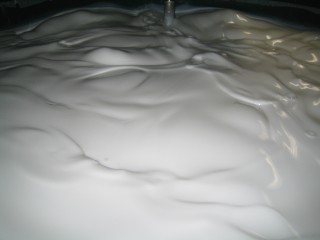
    Dry and iced microchannel evaporator (Schnabel et al. (2021): Microchannel-Heat Exchanger: Vermessung und Simulation bei Vereisung, DKV-Tagung Dresden 2021).
    © Fraunhofer ISE

    Dry and iced microchannel evaporator (Schnabel et al. (2021): Microchannel-Heat Exchanger: Vermessung und Simulation bei Vereisung, DKV-Tagung Dresden 2021).

    Project in the Business Area: Energy Efficient Buildings; Topic: Heat Pumps; Duration: 06/2023 - 05/2026

    more info
  • PV2FLOAT

    Technology development for floating PV power plants and their implementation for use on artificial waters

    © Fraunhofer ISE

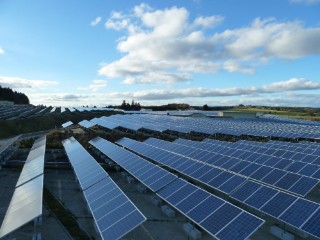
    PV2Float demonstrators on Mortkasee.

    Floating photovoltaics (FPV) refers to PV power plants whose modules are mounted on floating bodies on a body of water. The concept enables the expansion of renewable energies on artificial lakes without occupying scarce land areas. Flooded former opencast lignite mines alone offer a technical potential of about 26 GWP of installed capacity, assuming an occupancy of 0.6 MW/ha. In »PV2FLOAT«, an interdisciplinary team is investigating the opportunities and challenges of floating PV in order to create the technical, ecological and socio-economic conditions for tapping this potential. The project is dedicated to the further development of floating PV power plants with a view to cost reduction, integration into spatial planning and sustainable implementation on a megawatt scale. The economic viability and ecological impact as well as the potential and acceptance of the technology are analyzed with a focus on the conditions in Germany. The development and installation of several FPV systems with different system designs and each with an output of approx. 30 kWp on an open-cast mining lake in Lusatia form the basis for holistic concepts in terms of practicality, economic viability, environmental compatibility and social acceptance. | Duration: 05/2021 - 12/2025

    more info
  • GreenSolarModules

    Strengthening the German PV Industry for Effective Implementation of the Ecodesign Regulation and the EU Energy Label

    CO2 emissions of glass-foil and glass-glass modules for the various production processes (top) and share of energy, processes, components and transportation for the production locations China, Germany and the EU (bottom). The total global warming potential (GWP) is shown as kg CO2-eq/kWp(top, black) and g CO2-eq/kWh (top, green).
    © KoMoGer

    CO₂ emissions of glass-foil and glass-glass modules for the various production processes (top) and share of energy, processes, components and transportation for the production locations China, Germany and the EU (bottom). The total global warming potential (GWP) is shown as kg CO₂-eq/kWp(top, black) and g CO₂-eq/kWh (top, green).

    Up to now, the decision to buy solar modules has mainly been driven by price. Evaluation criteria such as recyclability, CO2 emissions during production or the avoidance of environmentally harmful substances play a subordinate role in the purchasing decision. For this reason, an ecodesign regulation with an associated energy label for solar modules is being prepared at EU level and is due to come into force in 2024. The aim is to provide customers with information on the sustainability of solar modules. In addition, solar modules that exceed certain limits are to be that exceed certain limit values. | Duration: 06/2023 - 05/2026

    more info
  • Liebesbrief

    Laser-Induced Bonding and Micro-Welding Contacts for Better and More Resource-Efficient Series Connection of Flexible Solar Cell Strings

    CO2 emissions of glass-foil and glass-glass modules for the various production processes (top) and share of energy, processes, components and transportation for the production locations China, Germany and the EU (bottom). The total global warming potential (GWP) is shown as kg CO2-eq/kWp(top, black) and g CO2-eq/kWh (top, green).
    © KoMoGer

    CO₂ emissions of glass-foil and glass-glass modules for the various production processes (top) and share of energy, processes, components and transportation for the production locations China, Germany and the EU (bottom). The total global warming potential (GWP) is shown as kg CO₂-eq/kWp(top, black) and g CO₂-eq/kWh (top, green).

    Up to now, the decision to buy solar modules has mainly been driven by price. Evaluation criteria such as recyclability, CO2 emissions during production or the avoidance of environmentally harmful substances play a subordinate role in the purchasing decision. For this reason, an ecodesign regulation with an associated energy label for solar modules is being prepared at EU level and is due to come into force in 2024. The aim is to provide customers with information on the sustainability of solar modules. In addition, solar modules that exceed certain limits are to be that exceed certain limit values. | Duration: 06/2023 - 05/2026

    more info
  • Laboratory test cell for PEM electrolysis
    © Fraunhofer ISE / Foto: Joscha Feuerstein

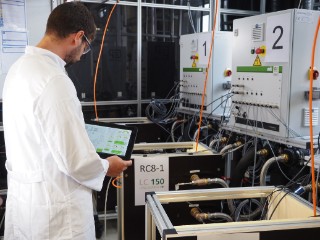
    Pressure and temperature stable laboratory test cell for PEM electrolysis for the characterization of cell components with an active area of 25 cm² and optional reference electrode.

    Project in the Business Area: Hydrogen Technologies and Electrical Energy Storage, Topic: Electrolysis and Power-to-Gas, Duration: 01/2021 - 12/2024

    more info
  • Photo of a measurement of the expansion of a battery cell using the optical device from Precitec Optronik.
    © Precitec Optronik GmbH

    Photo of a measurement of the expansion of a battery cell using the optical device from Precitec Optronik.

    In the early production phase of battery cells, the reject rate is particularly high, as conventional end-of-line tests primarily record the overall condition and can overlook minor defects. In the “Quaze” project, we are working with Precitec to develop a non-destructive measurement method that records the spatial expansion of pouch cells during charging and discharging cycles and uses this data to reconstruct a meaningful expansion field. In this way, the “good” expansion behavior that indicates defect-free cells is to be determined. AI evaluates the measurement data, detects deviations from the “good” reference pattern, and provides indications of faulty process steps. This accelerates corrective measures, reduces scrap and costs, and improves the overall environmental balance of cell production. | Duration: 04/2023 - 09/2026

    more info
  • digital plant recording and configuration with mobile devices
    © bad & heizung concept AG

    Using the steps of digital plant recording and configuration with mobile devices, such as smartphones and tablets, it should be possible to create a quick quote for the customer on site.

    In the heating, ventilation and air conditioning (HVAC) trade, consultation, stocktaking, planning and preparation of offers are very time-consuming processes, especially when upgrading existing systems. Each system must be individually configured and adapted to the technical conditions of the building and the habits of the users. This is especially true for complex and sustainable systems, such as heat pumps, fuel cells and solar-assisted hybrid systems. | Duration: 09/2021 - 08/2024

    more info
  • ki-pipelines for adaptive heat pump operation
    © Fraunhofer ISE

    ki-pipeline for adaptive heat pump operation

    Heat pumps are an effective solution for reducing energy consumption and the environmental impact of buildings, and for introducing renewable energy into the heat supply. However, the actual efficiency of heat pumps in practice does not always meet expectations. In addition to high occurring heat losses, the energy efficiency is reduced by an inappropriate system design, by misparameterization of the heat pump control and by undetected operating deficits. Therefore, the subject of the "AI4HP" project is the development of a new generation of "intelligent heat pumps", which adaptively adjust to changing boundary conditions with the help of artificial neural networks and thus increase energy efficiency while maintaining user comfort. | Duration: 09/2021 - 08/2024

    more info